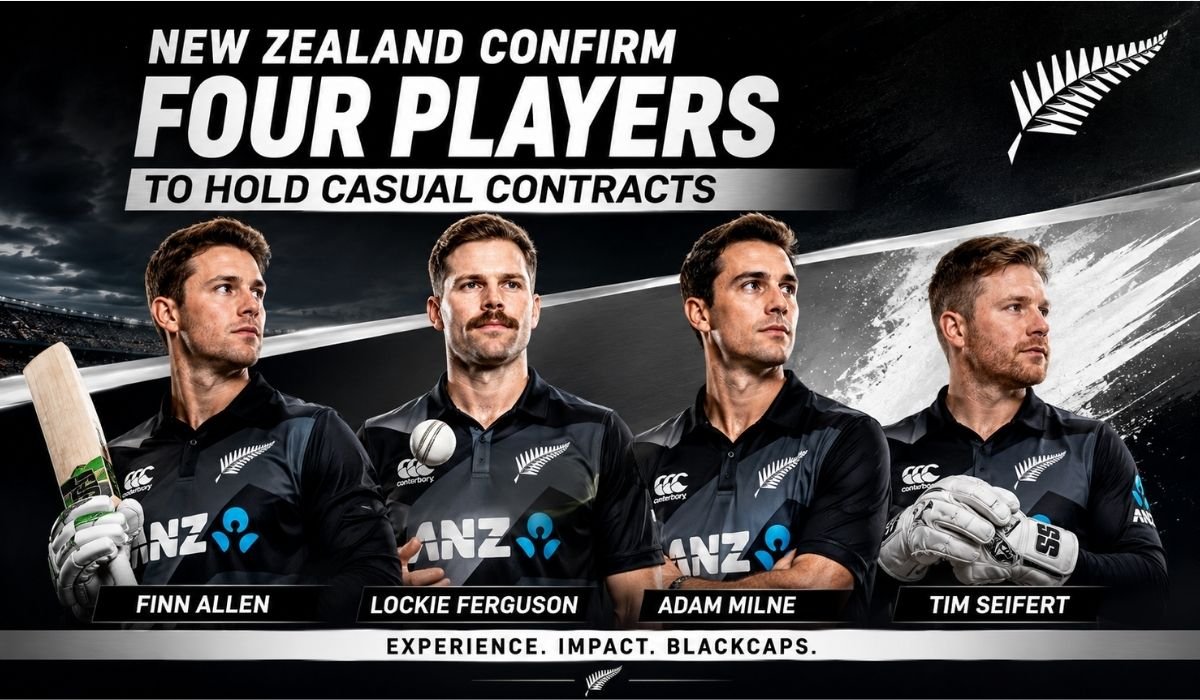
New Zealand confirm four players to hold casual contracts
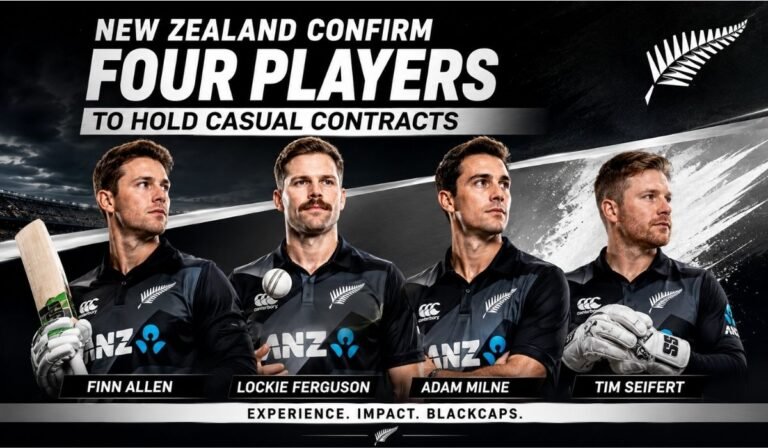
New Zealand confirm four players to hold casual contracts: New Zealand Cricket (NZC) has also confirmed that four seasoned white-ball specialists, Finn Allen, Lockie Ferguson, Adam Milne and Tim Seifert, have been given casual playing contracts for the 2026-27 season. The contracts will take effect from August 1 and guarantee the quartet’s presence for international duty while allowing them to compete in franchise cricket around the world.
This move underscores the evolution of NZC’s contract structure, which has been adapted to allow players to manage obligations between international cricket and lucrative T20 franchise competitions. All four players were on casual contracts last season as well, continuing a regime that has become a key part of New Zealand cricket.
Four Proven Match-Winners Retained
On the other hand, Finn Allen is still one of the world’s most destructive T20 openers, and Tim Seifert proved to be a consistent middle-order wicketkeeper-batter for the shortest format. Lockie Ferguson’s express pace and Adam Milne’s ability to generate bounce continue to be potent weapons for New Zealand in the white-ball context, as well as with the ODI World Cup 2023 just around the corner.
Focus on India Series and ICC Events
New Zealand selector Gavin Larsen said the decision was a good one, and the four players need to remain engaged with the national setup. “New Zealand faces a challenging white-ball schedule, starting with an important home series against India as well as gearing up for the 2027 ICC Cricket World Cup and the 2028 ICC T20 World Cup,” he noted.
Larsen hailed the Poultneys’ ability to win matches for their side, adding that the experience gained from franchise leagues around the world helps the national set-up as players are faced with pressure situations and can adapt to various conditions.
What Are Casual Contracts?
Casual playing deals, which by their very nature provide less certainty than conventional central contracts, are ideally suited to players who play in overseas T20 leagues on a regular basis. In that arrangement, players are not expected to be available for every international assignment but commit to specific series and major ICC tournaments.
The model allows New Zealand Cricket to keep veteran players who may decide against participating in the national system because of franchise commitments. As international T20 series become increasingly popular and lucrative, it is an important solution.
Changes From Last Season
A significant exclusion is former captain Kane Williamson, who retired last month from international cricket and had been part of the casual contract programme. Devon Conway and Blair Tickner have rejoined the list of centrally contracted players after they previously played under different contract agreements.
These contracts are further proof that they were really looking at trying to maintain a depth in the squad while understanding that modern international cricket also involves some pretty ruthless cuts.
Players Currently Active in Franchise Cricket
Meanwhile, cricket fans around the world are ready to see a bunch of players who are now all set with the franchise circuit and getting active
The four contracted players are all part of the group playing in the Major League Cricket (MLC 2026) tournament in America at present. They are Finn Allen (San Francisco Unicorns), Tim Seifert (Seattle Orcas), Lockie Ferguson (Washington Freedom), and Adam Milne (Texas Super Kings). They are likely to stay in fine fettle through franchise cricket ahead of New Zealand’s international commitments later in the year.
Looking Ahead
These casual contracts suggest New Zealand Cricket is prepared to update its player-care game plan, while continuing to have its leading white-ball players on hand for top-shelf global events. With key series against India and two ICC global tournaments to come, the Black Caps need to keep familiar faces like Allen, Ferguson, Milne and Seifert on hand.
As franchise cricket increasingly begins to shape the international calendar, New Zealand’s contract system could provide a template for other boards looking to strike a balance between players’ needs and those of an expanding global T20 landscape.
About the Author