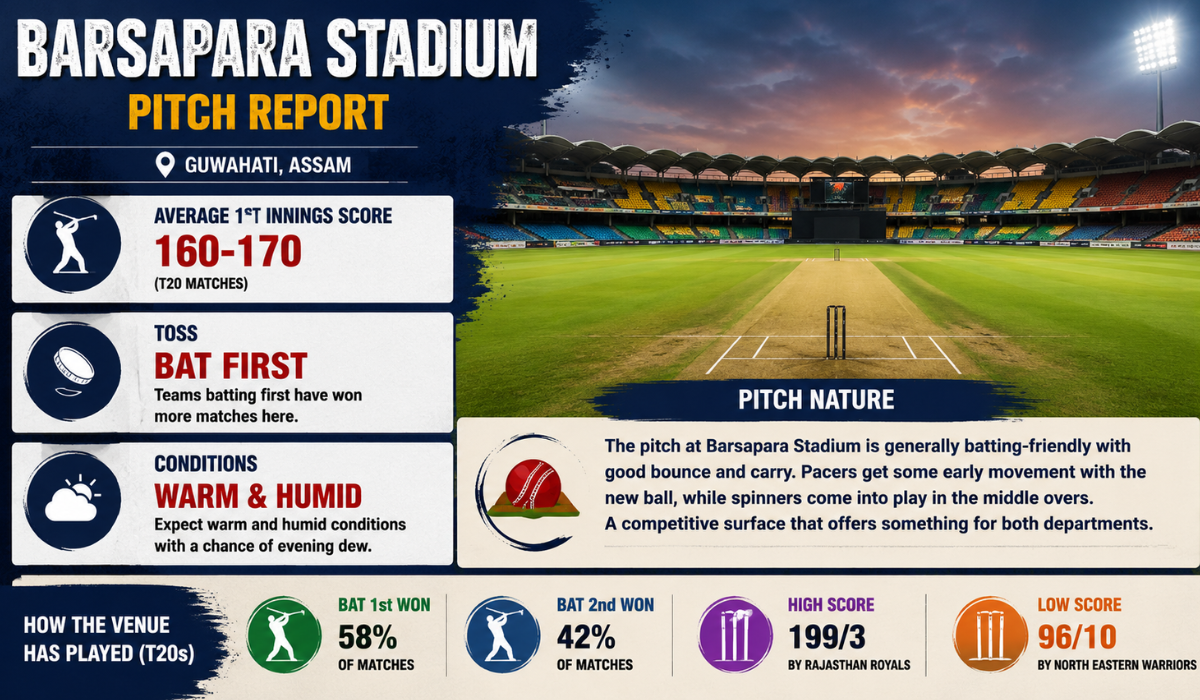
Barsapara Stadium Pitch Report
Barsapara Cricket Stadium (Official Name: Dr Bhupen Hazarika Cricket Stadium) is one of the most modern international cricket stadiums in India, and it is built with a whole new design and way of playing like Brisbane or Adelaide. This ground in Barsapara, on the outskirts of Guwahati in Assam, has made quite a name for itself since its establishment back in 2017. Firstly, it is the biggest cricket Stadium in Northeast India and has been a well-received international Stage for Cricket that is widely becoming Popular in the region.
The stadium, which was built under the guidance of the Assam Cricket Association ( ACA ), took around seven years to complete, with the Board of Control for Cricket in India ( BCCI ) financially supporting it at every step. The venue itself is named after legendary Assamese musician and cultural icon Dr Bhupen Hazarika, who was a luminary contributor to the region’s art and culture. For long cricket-loving people of Northeast India, this has come as a gratifying acknowledgement after so many years.
Barsapara, with a capacity of around 40,000 (expandable to about 55,000), is not just big but also technically advanced. Floodlights for day-night matches, indoor practice nets, a gymnasium, VIP lounges leading to modern dressing rooms and dedicated media facilities. The stadium, which hosted its first international fixture in October 2017 (T20I between India and Australia), has evolved into a T20I & ODI venue and from November 2025, it will also host Test cricket.
Stadium Overview at a Glance
Before diving deep into the pitch conditions and match data, here is a comprehensive overview of the Barsapara Cricket Stadium:
| Feature | Details |
| Official Name | Dr Bhupen Hazarika Cricket Stadium |
| Also Known As | Barsapara Cricket Stadium / ACA Stadium |
| Location | Barsapara, Guwahati, Assam, India |
| Established | 2012 (Inaugurated 2017) |
| Seating Capacity | 40,000+ (expandable to ~55,000) |
| End Names | Media End, Pavilion End |
| IPL Home Team | Rajasthan Royals (since 2023) |
| Straight Boundary | Approx. 65–70 metres |
| Square Boundary | Approx. 60–68 metres |
| First International Match | T20I vs Australia, October 2017 |
| First Test Match | India vs South Africa, November 2025 |
Read Also: Dewald Brevis Height in Feet
Barsapara Stadium Pitch Report: Nature and Behaviour
Though not yet a long list, the T20Is held at Barsapara Stadium have all added their part in maintaining its reputation as a ground for high-scoring games. First innings T20I scores at the ground average out to about 160 runs, but matches have routinely surpassed that figure. Chasing teams hold the clear historical advantage, winning three of their four T20I matches here – a direct reflection of how dew often plays a role in night games.
The most recognised T20I match here is still the October 2022 clash between India and South Africa, in which India made a massive score of 237/3, a total that remains the highest team total at this ground. The record was eventually broken as South African stalwart David Miller scored the fastest century for his nation in 47 balls of that game, but India registered a 16-run win to chase down the target. At the other end is Australia chasing down 225 in Barsapara (the highest chase ever at this ground) in November 2023.
Chasing teams are so dominant at this venue, India and New Zealand’s January 2026 T20I highlighted the point. Chasing an insignificant target of 154 runs to win, India accomplished the objective in only 10 overs a breathtaking execution moulded by Abhishek Sharma’s 68 off just 20 balls and Suryakumar Yadav’s 57 not out from 26 balls. It ruled that any target (in this case, even as low as 140) is chaseable at ease once dew sets in the second innings.
Pitch Behaviour Across Formats
| Format | Pitch Nature | Avg. 1st Innings Score |
| T20I | Batting-friendly, flat, true bounce | ~160 runs |
| IPL / T20 | Batting paradise, short boundaries | ~160–182 runs |
| ODI | Heavily favours batters, 300+ possible | ~260–300 runs |
| Test | Flat first 2 days, may assist spinners later | Variable |
Barsapara Stadium Pitch Report T20I, and Records at Barsapara
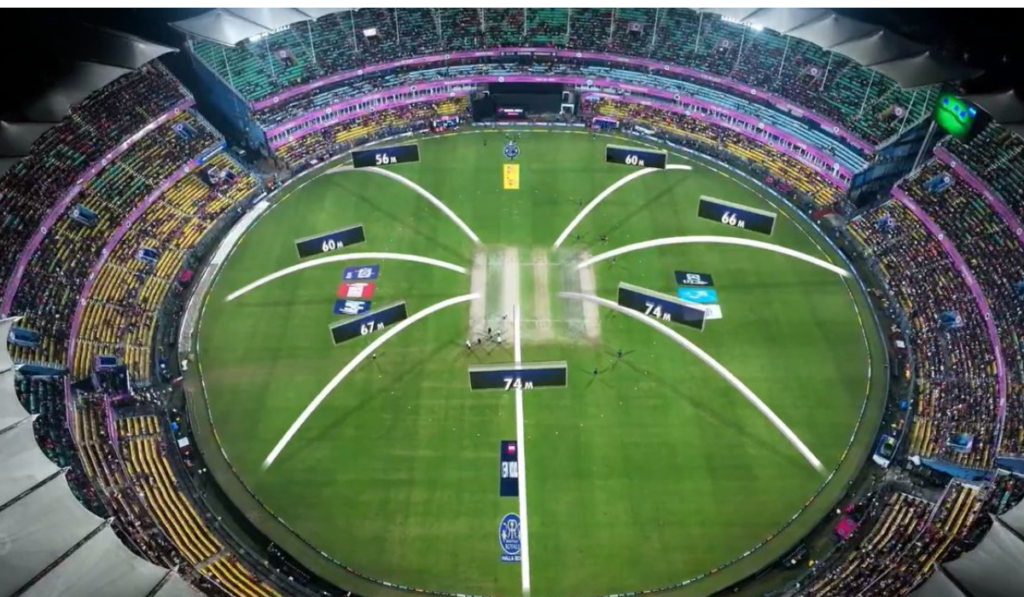
Barsapara Stadium has facilitated a modest yet reputable assemblage of T20Is, with each resonating its identity as an overall run-making surface. At the venue, the average T20I first-innings score is about 160, although lots of individual-match scores have well outstripped that. Just so you know, it does have a fairly strong record of bias toward the team batting second, with three out of four T20I matches won by the side chasing, probably an obvious telling sign that dew becomes a factor in evening fixtures.
The most famous outing here in T20S remains the India vs South Africa game back in October 2022, where India scored a towering total of 237/3, still the highest team score at this venue. South Africa’s David Miller scored a century in 47 balls in that final match, but it went in vain as India won the title by chasing down the target by 16 runs. For the other end of the scale, Australia chased 225 at Barsapara last November, which remains the highest successful chase at this ground.
There have been several instances where a chasing side has produced commanding performances at this venue, but none quite like that shown by India in their T20I against New Zealand back in January 2026. Chasing 154 in 10 overs, India got home with Abhishek Sharma scoring a whirlwind 68 (20b) and Suryakumar Yadav blasting 57 not out (26b). This game of this match reiterated the fact that once Nakko sets in during the 2nd innings, you can run down even a slightly sub-par target fairly easily.
T20I Statistics and Records
| Statistic | Record / Figure |
| Highest Team Total (T20I) | 237/3 – India vs South Africa (Oct 2022) |
| Lowest Team Total (T20I) | 118 – India vs Australia (Oct 2017) |
| Average 1st Innings Score (T20I) | ~160 runs |
| Highest Successful Chase (T20I) | 225/5 – Australia vs India (Nov 2023) |
| Fastest Fifty (T20I) | 22 balls – Glenn Maxwell (AUS vs IND) |
| Matches Batting First Won | 1 out of 4 matches |
| Matches Batting Second Won | 3 out of 4 matches |
| Notable T20I Result (2026) | India beat NZ by 8 wkts; chased 154 in 10 overs |
Barsapara Stadium Pitch Report in IPL and Records at Barsapara
In 2023, Barsapara Stadium received its first opportunity as an IPL venue when the Rajasthan Royals chose it to be their second home, marking the first time top-flight franchise cricket was played in Northeast India. The ground had held as many as eight IPL matches since then, including some of the most exciting matches at the tournament.
In all, 2023 saw the highest IPL total ever made at the venue, when Rajasthan Royals made 199/4 against Delhi Capitals, breaking the previous record of 210/4 set by RR themselves against Gujarat Titans in 2026. In contrast, the lowest IPL total is in March 2026 when Chennai Super Kings were shot out for just 127 before going down by eight wickets to the Royals, a match that underlined at this ground how powerful chasing teams can be.
Barsapara: Home ground for the cast. The main act is Balaji Crickets. Pride of Guwahati, Riyan Parag, the captain of Rajasthan Royals, topped the IPL batting list at this ground with 151 runs from six innings, adding a unique emotional significance to all RR home matches here. Yuzvendra Chahal leads the wicket-takers list with six wickets at this venue, and he is one of the bowlers who can get some grip out of his deliveries despite getting assistance from the dew later on, but still has a reason to hang around.
All three ran up quite the buzz as Barsapara hosted three Rajasthan Royals home matches this IPL 2026 season. On March 30, 2026, the RR vs CSK match was another one-sided affair with an eight-wicket victory for RR after bundling out CSK for just 127, one of the biggest home victories recorded by the Royals on this venue. Another high-scoring clash was the RR vs MI fixture on April 7, 2026, with rain falling in a 33% of taking place by then.
Read Also: Ishan Kishan Height in Feet
IPL Statistics and Records at Barsapara
| Statistic | Record / Figure |
| Highest IPL Total (all-time) | 210/4 – Rajasthan Royals vs Gujarat Titans (2026) |
| Previous Highest IPL Total | 199/4 – Rajasthan Royals vs Delhi Capitals (2023) |
| Lowest IPL Total | 127/10 – Chennai Super Kings vs RR (2026) |
| Highest Successful IPL Chase | 153/2 – KKR vs RR (2025) |
| Top Run-Scorer (IPL) | Riyan Parag – 151 runs at 30.20 |
| Top Wicket-Taker (IPL) | Yuzvendra Chahal – 6 wickets |
| Total IPL Matches Hosted | 8 matches (2023–2026) |
| Batting First Wins | 4 matches |
| Bowling First Wins | 3 matches (1 NR) |
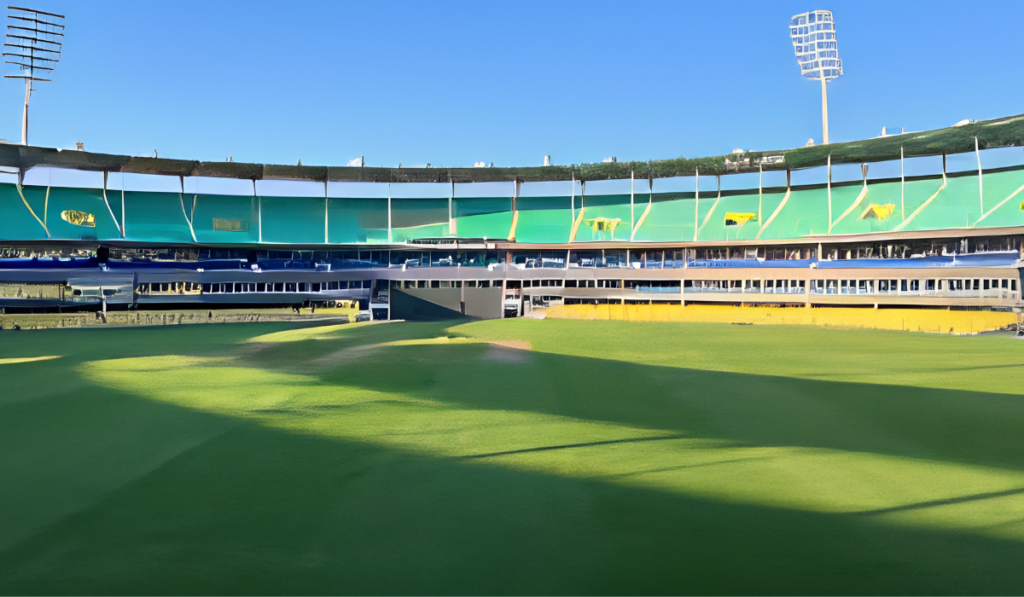
Barsapara Stadium Images
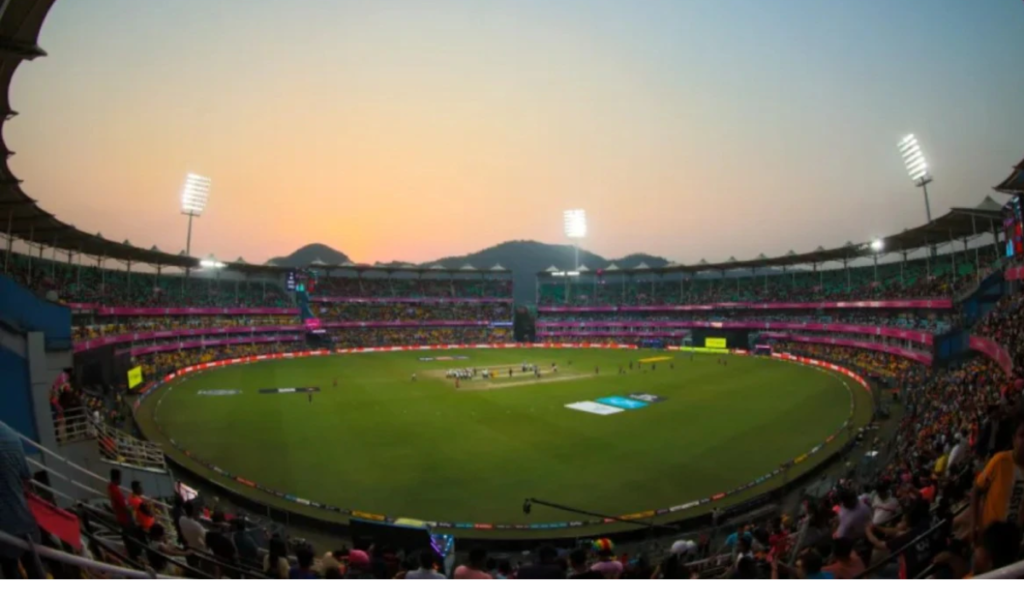
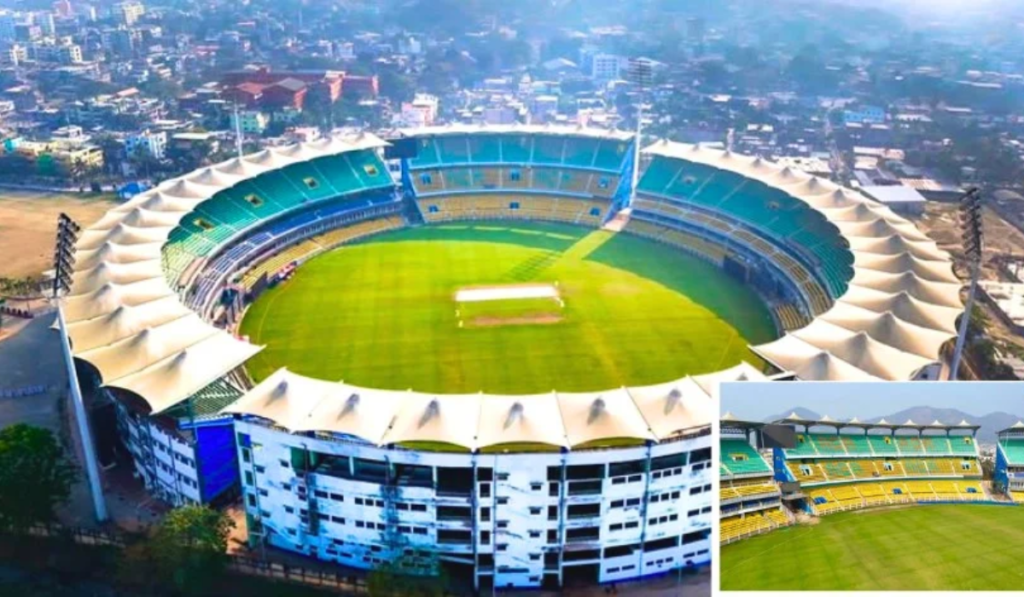
Toss Strategy at Barsapara: What the Data Says
First things first, the most discussed tactical aspect at Barsapara Cricket Stadium is the toss. And then the dew factor turns this into one of the biggest coin flips in Indian cricket. Tosses have become almost an immediate concession for captains at this ground in T20 formats played under lights. There is an absolute consensus on the need to bowl first, with data backing it unequivocally.
At Barsapara, teams batting second have won three out of four T20 internationals. The chasing win rate in IPL cricket, when the fielding team wins the toss and opts to bat, is known as “the second innings”/”chasing team” win rate, which analysts say gives one of them a considerable tactical advantage. Analysis for the 2026 tournament showed that the sides bowling first at Barsapara had vastly greater chances of victory, boosted by an unavoidable second-innings dew which renders spin impotent and makes a finger ball almost impossible to grip.
But bowling first is not the only way to win! One of only a handful of times when a large first-innings total managed to be tough enough to withstand dew-aided batting came in the 2023 IPL season, with Rajasthan Royals defending 199/4 against Delhi Capitals by 57 runs. Therein lies the lesson: T20 cricket teams setting a total first need to score well in excess of 180 to seriously hope of defending. Scores below 155 are at serious risk of being overtaken.
Toss Decision Guide by Format
| Scenario | Preferred Choice | Reason |
| Day-Night T20 | Bowl First | Dew advantage for chasing team |
| Afternoon ODI | Bat First | Fresh pitch, no dew factor |
| Morning Test | Bat First | Surface is flat and reliable early |
| IPL Evening Game | Bowl First | Second innings dew makes chasing easier |
Weather and Dew Factor at Barsapara
Guwahati’s geography and climate play a major role in shaping match conditions at Barsapara. The city sits in the Brahmaputra Valley and is known for high humidity throughout the year. During the IPL season (March-May), daytime temperatures hover between 30°C and 36°C, dropping to around 24°C during evening match hours. Humidity routinely exceeds 75-80%, and this is the primary cause of the significant dew that forms during the second innings.
The dew effect at Barsapara is not merely a cosmetic inconvenience. By the twelfth over of the second innings, the ball becomes noticeably slippery and wet. Spinners find it nearly impossible to generate revolutions on such a ball, and even pacers struggle to maintain control at the death overs. Captains have frequently spoken about the challenge of handling a wet ball at this ground, and analysts have confirmed that this dew-driven advantage for chasing teams is one of the most consistent patterns across all formats of cricket at this venue.
Rainfall is also a consideration, particularly from May onwards when pre-monsoon showers can disrupt play. Matches in the IPL have occasionally faced interruptions, triggering Duckworth-Lewis-Stern (DLS) method calculations. For the November Test match hosted in 2025, weather conditions were more stable but still significantly humid, which factored into pitch preparation strategies.
Barsapara’s Historic First Test Match (November 2025)

This has a lot to do with the geography and climate of Guwahati as well, which have quite an impact on match conditions at Barsapara. It is located in the Brahmaputra Valley and experiences high humidity throughout the year. In IPL Season (March – May), the daytime temperatures are between 30°C and 36°C, but in evening match timings, these drop to around 24 °C. Humidity not infrequently hovers above 75-80%, and humidity explains most of the large dew which tends to get on during the second innings.
That dew effect at Barsapara is not only an eyesore. The ball will be slippery and wet after the twelfth over of the second innings. For spinners, it is nearly impossible to impart revolutions on such a ball while also pacers fight for control in the last overs, too. Captains have often hinted at the difficulty in gripping a wet ball at this ground, and analysts confirmed that this accessory created by dew for chasing teams is one of those wee tips across all formats here.
Rain is also a factor, especially after May, when pre-monsoon showers can wash matches out. However, there have been interruptions during IPL matches, leading to the calculation of DLS whenever necessary. The weather was much more stable but just as humid in 2025 for the November Test match, where pitches were prepared with another level of humidity awareness.
ODI Pitch Report at Barsapara
Barsapara has hosted a small number of ODIs, all of which have produced high-scoring and entertaining Barsapara has only hosted a handful of ODIs thus far, but all such matches held at this venue have been high-scoring and produced an excess of derring-do. At the same time, this flat and true-bouncing surface becomes extremely good for batters in 50-over cricket. With the short boundaries, the fast outfield and a flat pitch making big first-innings totals almost inevitable here, teams have regularly posted and chased 300 or more at this ground.
Most notably, Barsapara hosted its only ODI match on 21 October 2018, where India chased down a target of318-reach against the West Indies in just 42 overs. This season also saw Virat Kohli and Rohit Sharma combining for a 246-run partnership, the most dominant ever batting display at this ground. Kohli himself scored two ODI tons at Barsapara, a venue that continues to present as a batters’ paradise even in the longer white-ball format. During the ODI between India and Sri Lanka in January 2023, India scored 373/7 and won by 67 runs, confirming that this ground is a high-scoring one for 50-over cricket.
Read Also: Jemimah Rodrigues Net Worth 2026
Pitch Report Analysis: Key Takeaways for Match Day
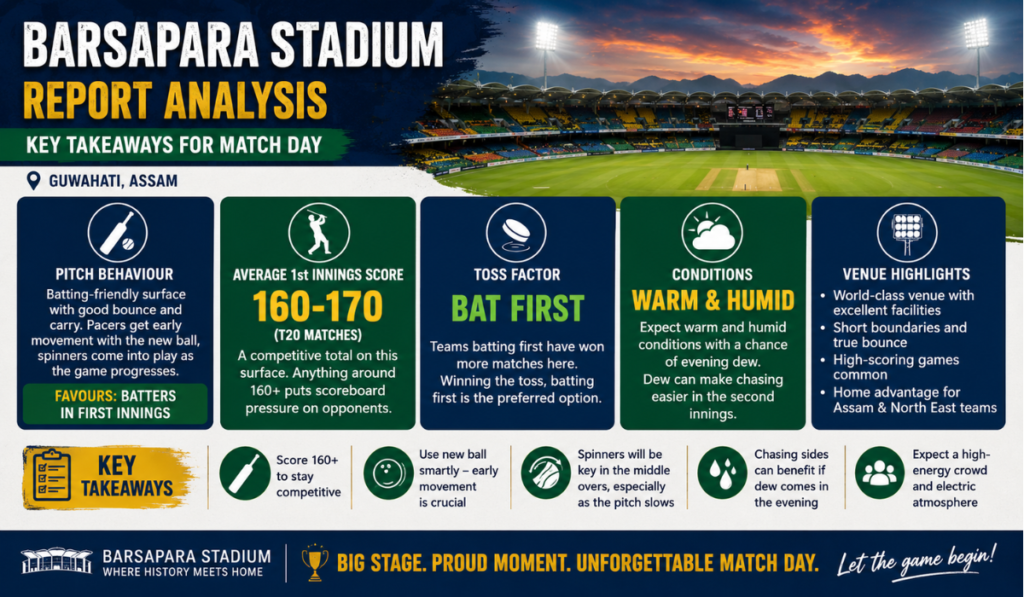
Here are the most significant tactics that teams and analysts should keep in mind while hunting for an approach to a match at Barsapara Cricket Stadium. All of these have been deduced from historical trends and available data cut-off as of October 2023.
The batting order and depth have an enormous impact at this ground. A pitch that stays flat and true throughout the course of a match affords obvious structural benefits to a team with deep batting lineups (i.e. capable of firing all the way down from No 1 to No 7). Those middle-order batters who are easily able to play horizontal-bat shots strong enough to leave Pawhiri Park and clear the very short straight boundary of just 65 metres here can be highly dangerous.
Seam-spin balance for the bowling attacks should be heavily weighted towards pacers in evening T20 matches. The spinners that are included must be of the type whose speed is faster, with a great amount of change between the highest and lowest speeds, for slow turn is either not created from the pitch nor advantageous in the second innings, as a wet ball helps batters.
In T20, 180-200 is the generally accepted score for teams batting first to be competitive, but looking at the 2026 data, this is fast becoming lacking. Around 215 has become the win threshold; scratch and scrabble to that power total on a conducive surface, and teams batting first begin to feel they will have enough, given the structural imperatives in such circumstances, which mean only extraordinary first-innings performances can topple chasing sides.
Frequently Asked Questions (FAQs): Barsapara Stadium Pitch Report
Q1. Pitch report for Barsapara Stadium today
Barsapara Stadium pitch: The Barsapara Stadium is more of a batting-friendly surface across formats (especially T20 and IPL cricket). The surface is relatively flat but offers true bounce and minimal assistance for bowlers, particularly after the initial couple of overs. The dew has a huge impact on evening matches, which makes the second team in the last innings outdo their opposition. At this venue, the average score in the first innings of a T20 match is approximately 160, with teams winning matches consistently while chasing.
Q2. Is Barsapara a batting or bowling ground?
The Barsapara Cricket Stadium is largely a batting pitch. Playing through the line is easy on a flat, hard pitch that provides true bounce and reliable carry. With its square boundaries (even at a mere 60–68 metres) and sheer speed, the outfield adds to even more chances of scoring! Bowler, especially spinners, also find it a bit difficult here, particularly in the second innings of evening matches when dew makes the ball wet and hard to grip.
Q3. Q2: What is the highest total at Barsapara Cricket Stadium?
The highest T20I total at Barsapara is 237/3, also by India against South Africa (October 2022). In that encounter, South Africa chased down 221/3 but fell short by 16 runs as India clinched victory. Highest Total: 210/4, Rajasthan Royals vs Gujarat Titans, 2026. The ground has seen scores of 373/7 (India vs Sri Lanka, 2023) in ODI cricket
Q4. Toss: Does it matter at Barsapara Cricket Stadium?
The toss is very important at Barsapara, more so in T20 and IPL cricket. Or nearly always, at least, since in evening matches, dew after the first innings provides a massive advantage to anyone chasing in the second half of the game and teams winning the toss almost always choose to bowl. Subsequent analysis of statistical data (until T20 WC #7) has suggested that teams batting second at Barsapara have won approximately 65% of their T20 matches. In T20 cricket, the win threshold for teams batting first is considered to be roughly 215 runs, and anything below it is in range.
Q5. Answer: Which IPL team is based at Barsapara Stadium?
Rajasthan Royals brought Barsapara Cricket Stadium back as their 2nd home ground ahead of IPL 2023. A local hero, the team’s captain Riyan Parag, hails from Guwahati, adding extra emotional value to these home matches. The Rajasthan Royals hosted their 3 home matches at Barsapara in IPL 2026 against CSK, KKR, MI and RCB.
Q6. Has Barsapara Stadium hosted a Test?
Yes. India played its maiden Test match in Barsapara, the second of the series against South Africa in November 2025. It was a historic moment for Northeast India cricket, and the home team was the runaway winners in the match. Scores: South Africa 489 & 260/5 declared, India 201 & 140. In a one-sided contest, South Africa hammered India by exactly 408 runs. It was described as flat but providing an even pace, which benefited South Africa’s seamers perfectly.
Q7. Boundary dimension Barsapara Cricket Stadium
The straight boundary is around 65–70 metres, while the square is between 60 and 68 metres at Barsapara Stadium. In fact, these dimensions are considered to be much shorter in comparison to many of the major Indian stadiums, which is believed to add heavily towards the venue’s reputation for high-scoring encounters. It is also an advantage in the fast outfield because even ground shots that have been well timed aren’t rolling slowly to the rope as they might at a slower surface.
Q8. Barsapara Cricket Stadium has a seating capacity of 40,000.
Barsapara Cricket Stadium has a capacity of around 40,000 people, but can even expand up to 55,000 for major events. Northeast India’s largest cricket ground. It consistently sells out for IPL and India internationals, generating a “buzzy” stadium, which players from both teams praised.
Q9. The first-innings average score at Barsapara in T20 cricket is 150.
Barsapara has an average first-innings score of around 160 runs in T20I fixtures. The average first-innings score in IPL cricket may be somewhere between 160 and 182 runs, depending upon the conditions and totally belching batters. Anything above 180 gives teams a fair shot at defending, but anything over 210 really tips the probability of winning in the batting-first team’s favour.
Q10. Barsapara, how does the weather play a role on match days?
The humidity in Guwahati is always high, often more than 75–80% during IPL season, which causes massive dew formation for evening matches. The dew makes the ball slippery and makes it difficult for bowlers (especially spinners) to grip, and gives a significant structural advantage to the chasing team in the second innings. The temperature during the IPL season reaches 30–36⋅C in day and about 24⋅C in the evening. From May onwards, there is also a fairly good chance of pre-monsoon rain, which can also halt play.
Conclusion About Barsapara Stadium Pitch Report
Guwahati: Barsapara Cricket Stadium in Guwahati district of Assam is one of India’s most rapidly developing cricketing arenas and a true symbol of the expansion of cricket in NE India. At Barsapara, the message is almost eternally succinct: this is a run-making ground with its flat surface, short boundaries, rapid outfield and a detectable dew-factor that, when playing T20 cricket in the evening, shifts by massive percentages towards teams chasing scores.
Barsapara is yet to deliver some of the most defining modern-day Indian cricket moments, ranging from India’s sensational 237/3 in a T20I against South Africa to those dominating home fortress performances of the IPL represented by Rajasthan Royals. The ground, which had previously only hosted ODIs and T20S, transformed into a fully-fledged international ground with the first Test match played there when India met Bangladesh in November 2025.
Understanding the Barsapara pitch report very well is a key thing for analysts, fantasy cricket players, team strategists and fans to predict the possible outcome of a match. This ground favours aggressive batting, and disciplinary bowling is punished, while it almost guarantees a spectacle. From Riyan Parag driving through the covers for his home fans to Abhishek Sharma smashing a T20I target down in ten overs, Barsapara Cricket Stadium has more than provided an example of where history is always created and great cricket.
Read Also: Godfather of Cricket in World || Umesh Yadav Net Worth 2026 || Baap of IPL
About the Author